← Blog · 13 Oct 2026 · By Prof. O. J. Abimbola
Artificial Intelligence: Why Can't Nigeria or Africa Build Its Own AI Ecosystem?
I once came across an intriguing claim about the early development of photography: that photographic technologies were originally calibrated primarily for lighter skin tones, which contributed to the difficulty of accurately capturing darker skin tones in photographs and videos.
While I cannot verify the specific story I read, it raises an important question about technology: Who develops it, whose realities shape its development, and whose needs does it ultimately serve?
This brings me to the ongoing global revolution in Artificial Intelligence (AI).
Today, countries and companies are making remarkable advances in AI. The United States is home to OpenAI (ChatGPT), Anthropic (Claude), and several other AI developers. China has DeepSeek, Baidu, and others, while France has Mistral AI.
These developments demonstrate how AI is becoming an increasingly important component of technological innovation, economic competitiveness, scientific research, and national development.
But where does Nigeria stand in this rapidly evolving landscape?
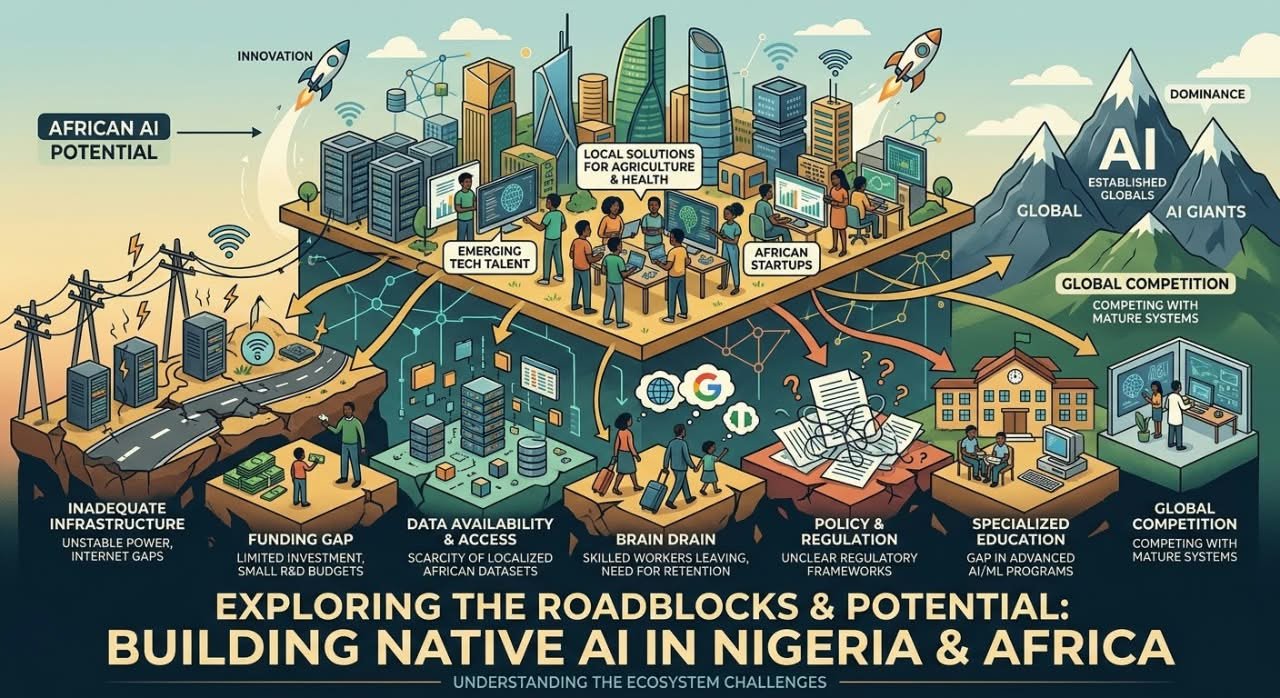
Although Nigerians and other Africans are actively using AI technologies, particularly through cloud-based platforms developed elsewhere, I believe we should be asking a more fundamental question: Why can't Nigeria develop and host its own large-scale AI systems, supported by data centres located within the country?
And if the financial, infrastructural, and technical requirements are too demanding for Nigeria to undertake independently, why can't the Economic Community of West African States (ECOWAS) or the African Union (AU) facilitate a regional initiative to develop indigenous AI capabilities?
Imagine AI systems developed with African realities in mind: systems trained on African languages, informed by our cultural diversity, and designed to address challenges in agriculture, education, healthcare, climate science, governance, and other sectors critical to our development.
Importantly, we do not necessarily have to manufacture every component of the technology ourselves before participating meaningfully in its development.
Many leading AI companies outsource the manufacture of the advanced semiconductor chips that power their systems. Instead, they build on hardware and computing infrastructure that is supplied by specialised technology companies. Furthermore, several of the world's prominent AI developers are privately owned enterprises, demonstrating that innovation does not have to originate exclusively from governments.
What Africa needs is a deliberate effort to bring together its universities, research institutions, technology entrepreneurs, private investors, and governments to develop a sustainable AI ecosystem. Such an effort would require investment in computing infrastructure, reliable electricity, technical expertise, high-quality datasets, and responsible AI governance.
I recognise that building competitive AI systems is both capital-intensive and technically demanding. Nevertheless, these challenges should motivate serious planning and collaboration rather than discourage ambition.
Africa should not remain primarily a consumer of technologies developed and shaped elsewhere. We should also contribute to designing, developing, training, and governing the intelligent systems that will influence our future.
The question, therefore, is not simply whether Nigeria or Africa can build its own AI capabilities.
It is whether we are prepared to make the long-term investments, develop the expertise, and establish the partnerships necessary to do so.
What do you think? Should Nigeria pursue a national AI development initiative, or would an ECOWAS- or African Union-supported approach be more practical?