← Blog · 14 Oct 2026 · By Prof. O. J. Abimbola
Is School Really a Scam? Education, Knowledge, and the Meaning of Success
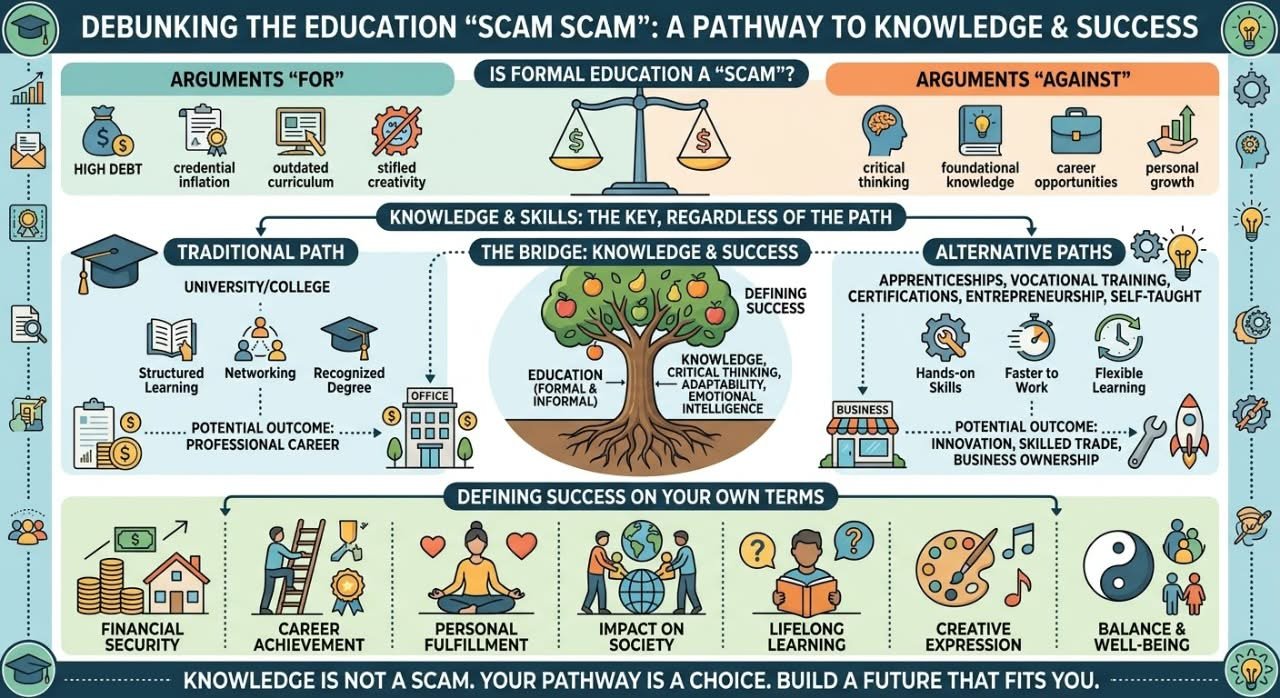
Not long ago, a popular Nigerian movie star was reportedly quoted as saying, “School na scam!" a Nigerian expression meaning “School is a scam.” The statement was widely interpreted by some as suggesting that education itself is a scam. But before accepting or rejecting such a statement, perhaps we should ask two fundamental questions: What is education, and what is a school?
Education, in its broadest sense, is the process of acquiring knowledge, skills, values, and understanding through learning and experience. A school, on the other hand, is an institution established to facilitate organised learning. The distinction is important because education is not confined to the four walls of a classroom, nor is schooling the only pathway to knowledge.
In this broader sense, every human being possesses some form of acquired knowledge or skill. It may therefore be more meaningful to describe someone as lacking education or expertise in a particular field than to dismiss that person as entirely uneducated.
For example, I may know absolutely nothing about the German language because I have never studied it. However, I am proficient in my mother tongue. Would it be reasonable to describe me as linguistically uneducated simply because I cannot speak German? Certainly not!
Consider another example: Imagine a farmer living in a remote Nigerian village who has never attended a formal educational institution. Through years of observation, experience, and knowledge passed down across generations, this farmer understands the local soil, planting seasons, rainfall patterns, crop behaviour, and environmental conditions.
Such a farmer may possess a depth of practical knowledge about local agricultural conditions that even a professor at a prestigious university, without comparable local experience, might not possess.
Would it be reasonable to describe this farmer as uneducated simply because they have never attended school? I would argue otherwise. The farmer may be formally unschooled, but certainly not without education or knowledge.
This brings me to another dimension of the movie star's reported statement: the suggestion that schooling has little value because he has become financially wealthier than many of his former professors.
This raises an even more fundamental question: Must the value of education always be measured by the amount of money it brings? To reflect on this, let us borrow an illustration attributed to the great ancient Greek mathematician, Euclid.
According to an anecdote preserved by the writer Stobaeus, a student once asked Euclid what material benefit he would gain from learning geometry.
Euclid reportedly instructed his servant to give the student a coin, since the student apparently expected financial profit from everything he learned.
Whether or not the incident occurred exactly as narrated, its philosophical message remains relevant today. Knowledge has intrinsic value, even when its immediate financial reward is not apparent.
Universities are not merely factories established to produce wealthy individuals. They are institutions dedicated to the preservation, creation, examination, and transmission of knowledge. Of course, education can improve employability, support entrepreneurship, generate wealth, and promote economic development. These are legitimate and important benefits. However, reducing the entire purpose of education to financial returns overlooks its intellectual, scientific, cultural, and societal contributions.
A professor may devote decades to understanding the fundamental laws of nature, advancing scientific knowledge, and training generations of students. One of those students may subsequently establish a successful business and become considerably wealthier than the professor.
There is nothing inherently contradictory about this outcome. The student's financial success does not invalidate the professor's intellectual contribution, just as the professor's academic achievements do not diminish the student's entrepreneurial accomplishments.
They may simply have pursued different goals, operated in different economic environments, or contributed to society in different ways. Indeed, many of the technological innovations that generate enormous private wealth today rest upon discoveries made by researchers whose primary motivation was not personal financial gain.
Perhaps our society needs to reconsider how it defines success and measures the value of education. We should celebrate entrepreneurs who create wealth, just as we should celebrate teachers, scientists, researchers, artisans, and farmers who create, preserve, and apply knowledge.
We must also acknowledge that formal education is not beyond criticism. Poor teaching, outdated curricula, unemployment, inadequate funding, and the disconnect between academic qualifications and labour-market opportunities are genuine problems that deserve serious attention. But these shortcomings are arguments for improving our educational institutions, not for dismissing education itself.
Ultimately, wealth is one measure of economic achievement, but it is neither the only measure of success nor a universal measure of knowledge. A society that measures the worth of education solely by the wealth of its graduates risks undervaluing the very knowledge upon which its future prosperity depends.
So, rather than asking whether school is a scam, perhaps we should ask: Are we educating people merely to earn a living, or are we also preparing them to understand the world, solve problems, create knowledge, and improve society?
I would be interested in hearing your perspective.